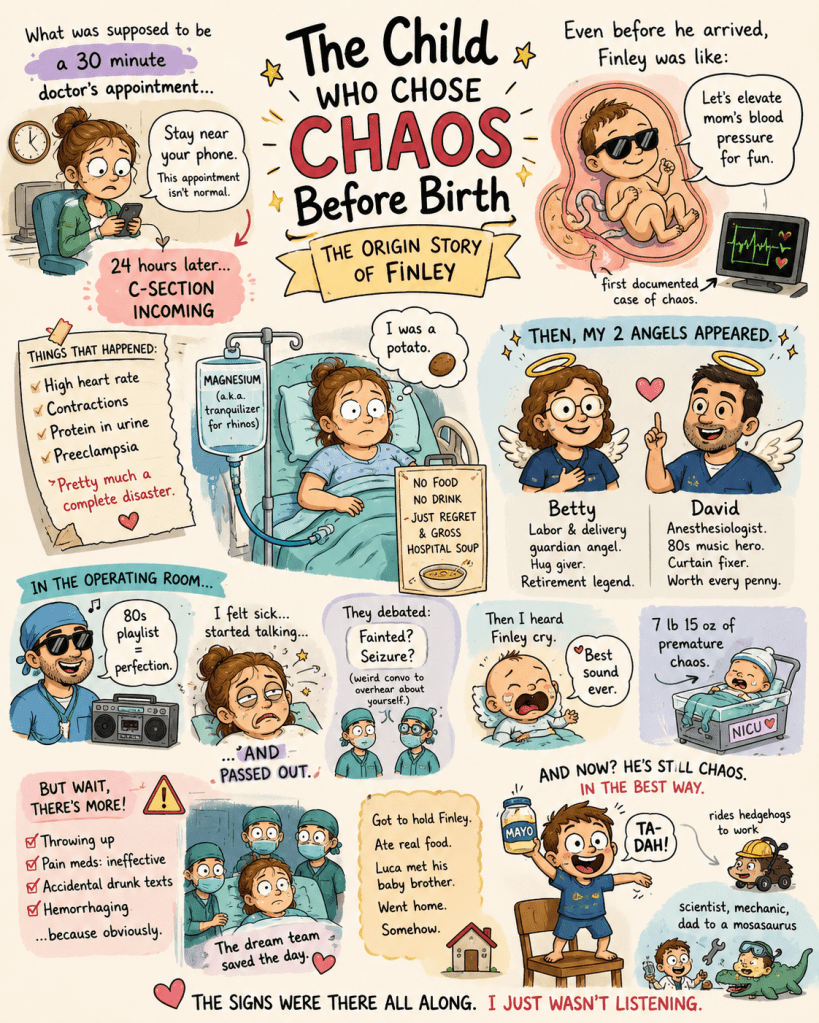
Looking back, I should have known exactly what kind of child Finley was going to be.
Today, he is the toddler who climbs furniture he shouldn’t, launches himself off things with complete confidence, proudly presents jars of mayonnaise while yelling “TA-DAH!”, and once spent an afternoon riding a toy hedgehog to work while simultaneously being a scientist, mechanic, and father to a baby mosasaurus.
The signs were there from the beginning.
On February 8th, 2024, I left work for what was supposed to be a routine 30-minute doctor’s appointment. Twenty-four hours later, I was having a C-section, hooked up to enough magnesium to tranquilize a rhinoceros, debating whether I had just passed out or seized in an operating room, and wondering if my unborn child had personally declared war on my cardiovascular system.
A few weeks earlier my blood pressure had started creeping up. My doctor put me on medication and ordered twice-weekly non-stress tests. Every appointment had been completely normal.
Naturally, this was the appointment where Finley decided normal was boring.
I had just started maternity leave coverage, so I left work early and told my students I’d see them the next day.
“You’re not leaving forever, right?” one of them asked.
“No,” I assured them. “I’ll see you tomorrow.”
Friends, I did not see them tomorrow.
At the appointment, the nurse found Finley’s heartbeat right away and left the room for a few minutes. When she returned she looked at the monitor and said,
“Wow, he’s really excited today. Did you have coffee this afternoon?”
I hadn’t.
“Hmm,” she said. “Well, let’s see if he settles down. Also, are you feeling those contractions?”
Those what now?
Apparently I was having contractions. Apparently they were consistent. Apparently my body had forgotten to notify me.
After about 25 minutes she took the monitoring strip to the doctor. When she came back she told me they’d monitor me a little longer.
Then a little longer became:
“If he doesn’t settle down, we’ll send you over to the hospital for additional monitoring.”
Then that became:
“Actually, we’re going to send you to labor and delivery now. You also have protein in your urine.”
Fantastic.
I texted my husband:
Stay near your phone. This appointment isn’t normal.
Understatement of the year.
After the appointment I went to the bathroom and cried. I was scared. That morning I had left before Luca woke up. I hadn’t seen him all day.
What if I had to stay?
What if I didn’t get to see him tonight?
I’d never spent a night away from him before.
I drove across the parking lot to labor and delivery trying not to completely lose it.
The nurses already knew I was coming.
“Jessica?” they asked.
I nodded and immediately started crying again.
One nurse gave me a hug and told me I was in the right place. I still remember her kindness.
After a mountain of tests, the doctors decided to keep me overnight.
They also informed me that I could no longer eat or drink until they decided what was happening.
Immediately, I became the thirstiest person who had ever lived.
Luca and Carlos came to visit that evening and hugging my little boy made everything feel a little less scary.
As soon as they left, a nurse informed me I could eat until midnight.
The kitchen was closed.
My dinner options consisted of crackers, pudding, and chicken noodle soup.
It was, without question, the worst soup I have ever eaten.
I slept very little that night.
The next morning the on-call doctor came in. She was wonderful—calm, direct, and honest.
While my blood pressure had improved, I officially met the criteria for preeclampsia.
She wanted to do the C-section that evening.
By this point I had accepted that I was having a baby that weekend. In fact, I was beginning to feel that perhaps the child actively attempting to make me have a stroke should be removed from my body sooner rather than later.
Plans were made.
Carlos called his mom to stay with Luca.
I was moved to a new room and informed that I would be starting a magnesium drip to prevent seizures.
The nurse warned me I would feel terrible.
This was a dramatic understatement.
Within minutes I had the physical capabilities of an overcooked noodle.
I could not get out of bed.
I could barely scroll on my phone.
I was a potato.
While placing the IV, the nurses struggled to find a vein and called in someone with special expertise.
In walked Betty.
Now, Betty isn’t just any nurse.
Betty was one of my nurses during Luca’s delivery years earlier.
Betty was the nurse who checked on me after my first C-section because she knew I was struggling.
Betty was one of my labor-and-delivery guardian angels.
I immediately started crying happy tears.
She told me she was retiring in a few months and was glad I remembered her.
I was glad too.
Then another nurse casually mentioned that David would be coming by to discuss my epidural.
I practically sat up in bed.
“David? The anesthesiologist?!”
“Yes?” she replied.
You guys, I LOVE David.
Technically, he was my anesthesiologist.
Emotionally, he was my emotional support anesthesiologist.
David had been there during Luca’s delivery too.
In fact, during my first C-section, the surgical curtain slipped and through some terrible combination of angles and a ceiling mirror, I suddenly found myself watching my own surgery.
I had no idea what to do.
I had no idea who to tell.
I wasn’t even sure if I was supposed to be seeing what I was seeing.
Then David appeared.
“Oops,” he said while fixing the curtain. “That was probably too much for you.”
Instant trust.
So when he walked into my room years later, I was thrilled.
“Well, hell yeah,” he said after hearing he had survived my first delivery experience. “Let’s do this again.”
At this point, I had both Betty and David.
Surely nothing could go wrong now.
Around 4 p.m., they wheeled me into the operating room.
Twenty-four hours earlier, I had gone to a routine doctor’s appointment.
Now I was preparing for surgery.
As David worked his anesthesiology magic, he turned on an 80s playlist.
It was perfection.
Then I started feeling awful.
Not normal awful.
Different awful.
I remember telling them I felt sick.
Then I remember opening my eyes to find David and my doctor standing over me.
“Well, that was fast,” my doctor said.
Apparently, I had passed out mid-sentence.
For several minutes, they debated whether I had fainted or had a seizure.
This is a very strange conversation to overhear when it’s about you.
Eventually, they decided I had probably just passed out.
Good times.
Carlos came into the room, and surgery began.
The weird thing about a C-section is that you aren’t in pain, but you can absolutely tell that people are aggressively rearranging your insides.
At one point, I asked David why my right side hurt.
“Because your organs are outside your body,” he replied casually. “Your body doesn’t like that. It’ll feel better when they put them back.”
Anesthesia is a fascinating profession.
Then I heard Finley cry.
And I cried too.
He was okay.
That was all I cared about.
At 36 weeks and 4 days, he was technically premature, although at 7 pounds 15 ounces, he was doing an excellent job disguising it.
After I held him briefly, he went to the NICU for observation.
Carlos went with him.
I headed to recovery.
This is where Finley decided the story needed one more plot twist.
Actually, several.
First, I spent nearly an hour throwing up despite having nothing in my stomach.
Then the pain medication was not working particularly well.
Then I accidentally started sending what can only be described as medically induced drunk texts to a coworker instead of my husband.
Then I started hemorrhaging.
Suddenly, there were doctors everywhere.
There was David again.
Thankfully, they were able to stop the bleeding, and by the next morning, I was doing much better.
The magnesium helped me sleep.
I got to hold Finley again.
I got to eat actual food after nearly two days.
Carlos brought Luca to meet his baby brother.
And somehow, despite everything, things started feeling normal again.
Betty was my nurse throughout much of the weekend.
I like to think she requested me, though I’ll never know.
By Sunday, I was discharged.
It is absolutely wild that society allows you to leave the hospital two days after major abdominal surgery, carrying a newborn.
It is even wilder that you’re expected to heal, care for yourself, care for a baby, and continue parenting a toddler.
Yet somehow people do it every day.
At the time, I worried constantly about Luca. I worried about whether he still felt loved. I worried about how he was handling becoming a big brother.
Like most mothers, I carried enough guilt to power a small city.
Now, more than two years later, I can confidently say the signs were there all along.
The child who elevated my blood pressure before birth now climbs on chairs, falls into dog bowls, loses pacifiers by throwing them into the darkness, and regularly attempts activities that seem specifically designed to test the laws of physics.
I used to joke that he was trying to kill me before I ever held him.
Now I know that’s not quite true.
Finley wasn’t trying to kill me.
He was simply introducing himself.
Some babies arrive quietly.
Finley arrived with plot twists, an 80s soundtrack, two guardian angel medical professionals, a NICU stay despite weighing nearly eight pounds, a hemorrhage, and enough drama to fuel an entire television season.
And honestly?
I wouldn’t expect anything less from the kid who thinks mayonnaise is a personality trait.


Leave a Reply